





Kyrana Hulstein and Haydn Walker, ‘Thom Browne v adidas and Babek v Iceland: The Challenges Associated with Non-Traditional Trade Marks (March 2026) Intellectual Property Forum Journal 143.'
In two recent United Kingdom (“UK”) Court of Appeal decisions, the courts considered the meaning of a “sign” in section 1 of the Trade Marks Act 1994 (the “TMA”). In particular, the courts navigated the interplay between pictorial representations and written descriptions and the difficulties associated with colour and position marks.
Background
Section 1(1) of the TMA defines a trade mark as a sign capable of being represented in the register and distinguishing the goods or services of one undertaking from those of other undertakings. A trade mark may consist of words, designs, letters, numerals, colours, sounds or the shape of goods or their packaging.
In 2019, section 1(1) was amended to include the wording “in a manner which enables the registrar and other competent authorities and the public to determine the clear and precise subject matter of the protection afforded to the proprietor”. This amendment codified the requirements for the registrability of a trade mark set out in Sieckmann,1 namely that a trade mark must be clear, objective, precise, self-contained, durable, intelligible and easily accessible (known as the Sieckmann criteria).
In two decisions handed down on the same date, Arnold LJ, sitting in the Court of Appeal, took the opportunity to clarify how the Sieckmann criteria apply in practice: first, in Thom Browne v adidas2 and then, in Babek v Iceland.3 Each of these decisions is discussed in turn below.
Thom Browne v adidas
These proceedings arose from long-running tensions between well-known sportswear brand adidas and luxury fashion brand Thom Browne over the use of stripes. Thom Browne sought declarations that sixteen of adidas’ UK trade mark registrations were invalid due to lack of registrability and distinctive character (sections 1(1) and 3(1)(b) of the TMA, respectively) or, alternatively, should be revoked for non-use. The registrations in issue covered three stripes applied to articles of clothing, footwear, bags and hats.
At first instance, Joanna Smith J held that eight of adidas’ registrations were invalid because they did not meet the threshold for registrability in section 1(1) of the TMA. Thom Browne’s distinctive character and non-use attacks largely failed. Adidas appealed the finding for six of the trade marks, but the Court of Appeal ultimately dismissed the appeal.
Position Marks
It was common ground that adidas’ marks were position marks; that is, marks consisting of a visual element (here, stripes) combined with a position on the goods. As the Court of Appeal observed, the distinctiveness of a position mark typically derives at least in part from its positioning.
The Legal Framework
Arnold LJ observed that three independent and cumulative requirements must be satisfied for a trade mark to be registerable:
- It must be a sign
- The sign must be capable of being represented graphically
- The sign must be capable of distinguishing the goods and services of one undertaking from those of other undertakings.
The appeal focused on the first two conditions.
Drawing on authorities such as Sieckmann, Heidelberger Bauchemie,4 Dyson,5 Spear v Zynga6 and Nestlé v Cadbury,7 Arnold LJ concluded that a written description which embraces a multiplicity of signs does not comply with the first condition. For example, in Nestlé, the offending trade mark’s description included not just the colour purple, but signs in which the colour purple predominates over other colours and matters, thereby designating an unknown number of signs. In Dyson, the applicant sought to register all conceivable shapes of a transparent collecting bin forming part of the external surface of a vacuum cleaner, which was held not to constitute a “sign” because it contemplated a multitude of different appearances.
The Court emphasised that these requirements exist to ensure legal certainty. For a mark to perform its essential function as an indication of origin, it must be perceived by the public in a clear and unambiguous manner. Such clarity is also essential to assessing identity or likelihood of confusion with other marks, as a mark that could be interpreted in multiple ways would produce inconsistent answers to the question of identity/similarity of marks.
Why adidas’ Registrations Failed
Each of the registrations combined:
- A pictorial representation showing three stripes placed in a particular way on a garment.
- A written description stating that the stripes ran along “one third or more” of the relevant part of the garment (sleeve, leg or side).
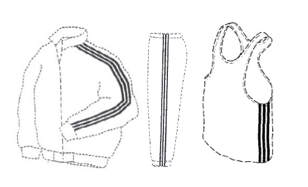
Crucially, adidas’ own case was that the images were illustrative only, and that the written descriptions defined the scope of the marks. The Court of Appeal agreed with the first instance judge that this created legal uncertainty. The phrase “one third or more” allowed for substantial variation in:
- The length of the stripes.
- Their starting and finishing points.
- Their precise positioning around the sleeve or leg.
- The overall visual impact of the sign.
These were not minor variations; they produced a wide range of materially different appearances, most of which were not depicted on the register at all. The Court rejected the idea that this amounted merely to a single sign whose appearance varied within permissible variations. The registrations effectively covered multiple signs and this ambiguity gave the proprietor an unfair competitive advantage.
The Court rejected adidas’ submission that evidence of use should have been taken into consideration. Such evidence did not shed any light on how the relevant public would understand the written descriptions, and in any event, cannot cure failure at the threshold stage. Whether a mark qualifies as a trade mark at all is a logically anterior question to that of whether it has distinctive character for the goods and services in question. A mark that fails to qualify as a trade mark cannot be saved by showing it has acquired distinctiveness.
Babek v Iceland
The dispute in Babek v Iceland arose from infringement proceedings in which Iceland counterclaimed that Babek’s trade mark was invalid. The parties agreed that the Court should determine the validity of the registration (despite the application being brought for summary judgment).
The Trade Mark
Babek owned a trade mark consisting of a pictorial representation of its logo (see below), accompanied by a written description stating “Gold Oval with Embossed BABEK writing” and claiming the colours gold and black (the “Babek Mark”).

Iceland argued that the registration was invalid because it failed to meet the statutory requirements in section 1(1) of the TMA that a trade mark must constitute a single “sign” and be capable of being represented graphically with sufficient clarity and precision. In particular, Iceland claimed that the written description was ambiguous because it failed to specify the exact hues of colour and by referring to “embossed” lettering which implied a 3D mark or multiple possible variants.
The First Instance Decision
In the Intellectual Property Enterprise Court (“IPEC”), HHJ Hacon rejected Iceland’s validity challenge. The judge found that the registration would be understood by a reasonable reader as the figurative mark shown in the pictorial representation, with the written description merely highlighting key features.
Iceland appealed the decision, arguing (amongst other things) that the judge had erred by applying a “capacity to distinguish” test when assessing clarity and precision, by placing excessive weight on the categorisation of the mark as figurative, and by underestimating the ambiguity created by the colour and embossing references.
The Court of Appeal’s Reasoning
The Court of Appeal reviewed the case law on registrability and confirmed the requirements of a sign discussed above. It accepted that the judge had erred in law by applying a “capacity to distinguish” test prior to the logically anterior questions of whether the mark constituted a sign and whether it was represented with sufficient clarity, which must be answered independently of distinctiveness. However, the Court did not think this affected the outcome. Taking the registration as a whole, the Court held that there was no inconsistency between the categorisation of the mark as figurative, the pictorial representation, and the written description.
Iceland argued that the inclusion of the word “embossed” in the description suggested that the sign was a 3D embossed badge, and so the visual representation shown was just one image of this 3D sign. Arnold LJ disagreed. Although acknowledging that on a literal reading “embossed” could suggest that the mark was intended to be a 3D mark represented in two dimensions, Arnold LJ found that the reasonable reader would understand “embossed” to refer to “the visual effect created by the shadowing of the letters” and noted that other features such as the shadowing of the studs, the frame around the oval and the silvery highlights would also be appreciated by the reasonable reader as contributing to this visual effect.
Iceland had also argued that the colours claimed in the registration lacked precision. Arnold LJ disagreed, finding that the reasonable reader would understand the words “gold oval” to be a concise description of the pictorial representation, and “gold, black” as a shorthand way of identifying the main colours visible in the pictorial representation. It was not an attempt to claim a range of unspecified colours. Arnold LJ did however reject HHJ Hacon’s finding that the pictorial representation allowed for “minor variations in hue”. Counsel for Babek had tried to defend this interpretation, but Arnold LJ found nothing in the description to suggest that the pictorial representation was merely illustrative or permitted colour variations. In practice, this finding did not have a profound effect, as the Babek Mark could still be enforced against similar signs with only slight variations in hue.
As a result, Arnold LJ found that the Babek Mark was a clear and precise sign, namely that depicted in the pictorial representation. Therefore, the mark was valid and the appeal was dismissed.
Newey LJ and Zacaroli LJ both agreed with Arnold LJ’s reasoning. The latter added that any attempt to describe the pictorial representation in the level of detail which Iceland claimed necessary (having identified 25 pantone hues of gold and 18 pantone hues of black) would be practically unworkable.
Takeaways
Both cases stress that a trade mark must meet the requirement of section 1(1) of the TMA of being a single, clear and precise sign. However, it is clear from these decisions that while overly broad trade marks risk invalidation, the courts will take a reasonable approach to interpreting signs and only where a registration would confer an unfair competitive advantage will the courts interfere.
In Babek, the Court held that the mark met this threshold despite apparent inconsistencies between the mark’s categorisation, pictorial representation and written description. This finding will be particularly relevant for more complex marks and those with non-traditional elements such as colours or visual effects (e.g., embossing). The decision also suggests that failure to specify a colour’s pantone reference is not always fatal to the mark’s registrability (although it remains good practice to do so). In adidas, however, the broad wording of the three-stripe position marks went beyond the illustrations, thereby creating multiple possible signs and failing to define the sign with sufficient clarity and precision.
Brands seeking to protect different variants of a mark are best advised to file multiple, more specific applications.
1Case C-273/00 Sieckmann [2002] ECR I-11754.
2Thom Browne v Adidas AG [2025] EWCA Civ 1340.
3Babek International Ltd v Iceland Foods Ltd [2025] EWCA Civ 1341.
4Case C-49/02 Heidelberger Bauchemie GmbH [2004] ECR I-6129.
5Case C-321/03 Dyson v Registrar of Trade Marks [2007] ECR I-687.
6J. W Spear & Son Ltd v Zynga Inc [2013] EWCA Civ 1175, [2014] FSR 14.
7Société des Produits Nestlé SA v Cadbury UK Ltd [2013] EWCA Civ 1174, [2014] RPC 7.
/Passle/5f3d6e345354880e28b1fb63/MediaLibrary/Images/2025-09-29-13-48-10-128-68da8e1af6347a2c4b96de4e.png)
/Passle/5f3d6e345354880e28b1fb63/SearchServiceImages/2026-10-14-15-59-20-619-6acfa6d86432c6c1a4f50582.jpg)
/Passle/5f3d6e345354880e28b1fb63/MediaLibrary/Images/2026-10-14-13-50-16-944-6acf8898a81c552c14eaf07b.jpg)
/Passle/5f3d6e345354880e28b1fb63/SearchServiceImages/2026-10-14-10-47-01-769-6acf5da591778041f005d442.jpg)