


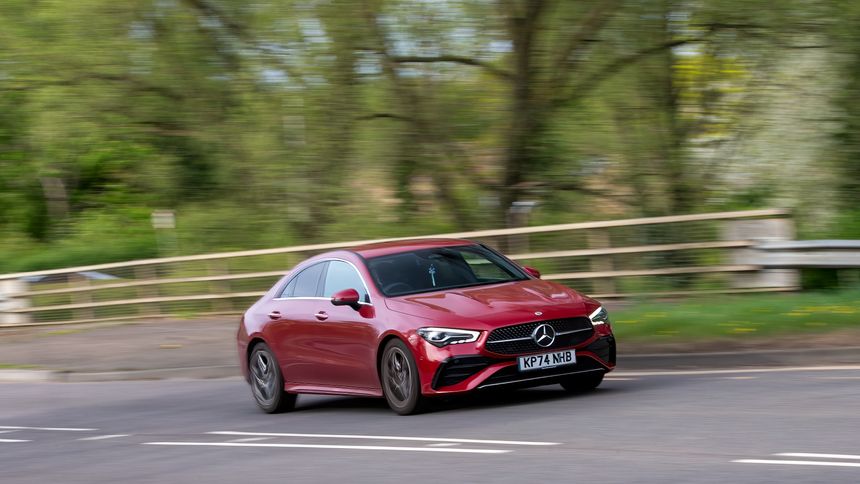

The EUIPO’s First Board of Appeal overturned a partial refusal and allowed Mercedes-Benz’s radiator grille design to proceed to registration for class 12 goods. The decision confirms that vehicle’s design components, specifically radiator grilles, can possess inherent distinctiveness where their configuration sufficiently departs from the standard practices of the industry sector concerned.
Background
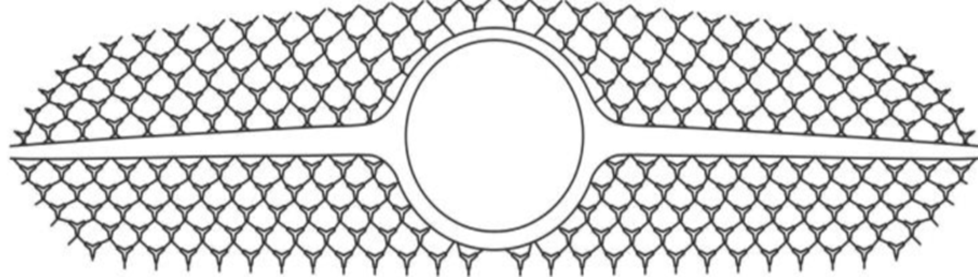
Mercedes-Benz Group AG (‘Mercedes’), the well-known car manufacturer, filed an EU trade mark application (the “EUTM”) for the above figurative mark in relation to goods in class 12 (“vehicles; radiator grills of metal for vehicles; radiator grills, not of metal, for vehicles”) and class 28 (“games and toys; games; toys”).
The Examiner raised a partial absolute grounds objection on the basis of Article 7(1)(b) EUTMR considering that the EUTM lacked distinctive character in relation to “radiator grills of metal for vehicles; radiator grills, not of metal, for vehicles” in class 12.
In support of the objection, the Examiner found that:
- While the overall design of a car can be a recognisable feature of the product, the same does not necessarily apply to individual design components, i.e. a radiator grille. A graphic depiction of parts of the final product is not understood by the relevant public in the same way as a conventional trade mark, which would not show the product itself.
- The appearance of the radiator grille did not depart significantly from common radiator grille designs in the automotive sector.
- Consumers tend to focus more on brand names or labels rather than on the shape or design of a product. The EUTM did not contain any logo that could serve as an indication of origin, but merely features a circular space that might be used to place such a logo.
- Although Mercedes argued that the grille’s mesh is made up of distinctive star shape that is itself registered as a trade mark, even the highly attentive consumers would not identify these features as stars. Instead, they would perceive only a decorative grid-like pattern made up of three-pointed shapes.
Mercedes appealed the Examiner’s decision.
The Board of Appeal’s decision
The Board held that the EUTM possessed the minimum required level of inherent distinctiveness, even though it consisted of the product’s appearance. In its decision, the BoA reiterated the usual principles, including that the distinctive character of a trade mark application is not subject to a finding of a specific level of the artistic creativity or imaginativeness on the part of the applicant. The Board considered as follows:
Relevant public and level of attention – radiator grilles are primarily aimed at automotive professionals, who generally pay close attention due to their knowledge and professional expertise. However, an increased level of attention does not lower or alter the standard for assessing the distinctiveness character of the trade mark at issue.
Distinctiveness of a mark consisting of a depiction of the product itself – when a sign consists of the product’s appearance, consumers do not automatically perceive it as an indicator of origin as they would do with a word or a figurative mark independent from the appearance of the product. It is settled case law that, for such marks, distinctiveness exists only if the design departs significantly from the standards commonly used in the relevant sector. There is no need to prove that identical shapes exist on the market; the test focuses on deviation from the norms or customs.
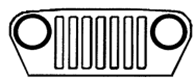
Radiator grilles and headlamps have already been recognised as brand identifiers in the automotive sector – the Board relied on established case law to affirm that radiator grilles are not merely functional features but are an essential element of the appearance of a vehicle and can therefore serve as an indication of origin. It cited Calandre (T-128/01, dated March 2003), which recognised that the figurative sign below has a minimum degree of distinctive character in respect of the class 12 goods.
The same reasoning was extended by the General Court decision regarding Volvo’s headlamp design mark (T-260/23) – our article about this decision can be found here. In consideration of these principles, the BoA considered that the EUTM cannot be denied distinctive character.
The assessment must be limited to the mark as filed – the Board agreed with the Examiner that Mercedes could not rely on the star-shaped micro-elements within the mesh pattern to establish distinctiveness, as these details are not visible in the trade mark as filed. Trade mark assessment must be based solely on the sign in its submitted form, not on features discernible only in real-life use.
Distinctiveness arose from the combination of the design elements – the Board noted that the EUTM consisted of a grille with an elongated rectangular outline, with short angled sides, a central circular element, integrated into a tapering central bar. This particular composition was found to create a visual impression that is capable of being memorised by consumers and distinguishing Mercedes’s goods from those of the competitors. In this respect, the Board found that the Examiner failed to appreciate the distinctiveness arising from the overall combination of the grille’s structural elements. The combination of all elements is a memorable design that materially differs from typical radiator grille patterns, regardless of whether the consumer recognises the circle as a potential logo holder.
Since only a minimal level of distinctiveness is required to overcome an objection under Article 7(1)(b) EUTMR, the Board concluded that the EUTM met this threshold. Accordingly, it annulled the Examiner’s refusal and ordered that the EUTM proceed to publication for the covered 12 goods.
This decision is a positive development for brand owners seeking to protect, as registered trade marks, elements of their products.
/Passle/5f3d6e345354880e28b1fb63/MediaLibrary/Images/2025-09-29-13-48-10-128-68da8e1af6347a2c4b96de4e.png)
/Passle/5f3d6e345354880e28b1fb63/SearchServiceImages/2026-10-16-15-24-05-723-6ad24195a0542974e7f80727.jpg)
/Passle/5f3d6e345354880e28b1fb63/MediaLibrary/Images/2026-10-15-15-58-57-806-6ad0f841df7274b811722beb.png)
/Passle/5f3d6e345354880e28b1fb63/SearchServiceImages/2026-10-14-15-59-20-619-6acfa6d86432c6c1a4f50582.jpg)