





Ben Lammin and Daniel Owen recently attended Cambridge Tech Week where Professor George Malliaras FRS used his keynote speech to highlight a familiar challenge for the UK’s medical technology sector: promising ideas emerging from universities often struggle to progress beyond proof-of-concept.
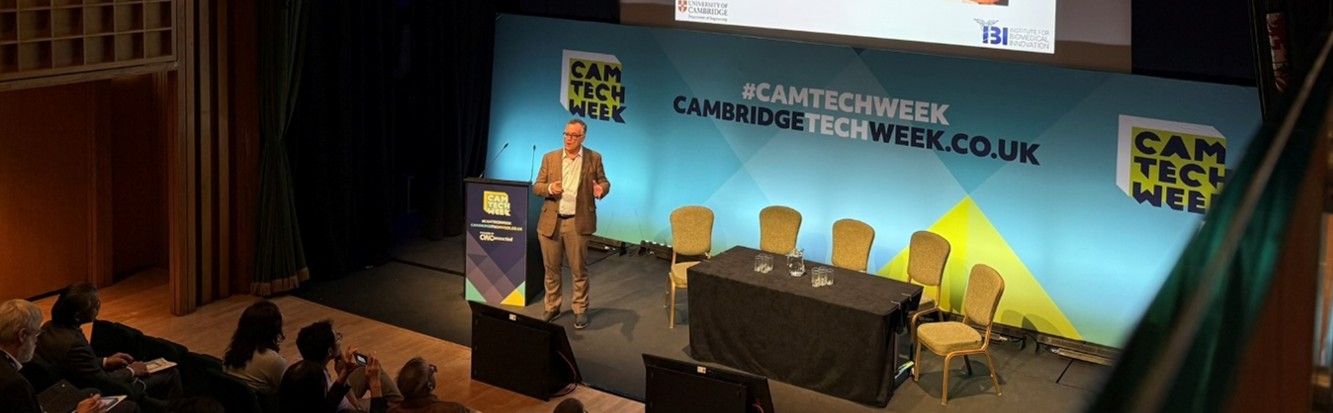
At Cambridge Tech Week 2026, Professor George Malliaras FRS used his keynote speech to highlight a familiar challenge for the UK’s medical technology sector: promising ideas emerging from universities often struggle to progress beyond proof-of-concept.
For medtech spinouts, that challenge can be especially acute. The journey from academic research to a clinically validated product is long, expensive and highly regulated. It can involve prototyping, design validation, clinical trials, manufacturing scale-up and regulatory approvals before a product is ready for market. For investors, particularly at the earliest stages, that can make medtech a difficult proposition - the capital requirement is high, the timelines are long and the commercial risk remains significant.
As a result, promising technologies emerging from leading research institutions can struggle to attract the support they need at the point when they are most vulnerable, causing some projects to stall, fail to commercialise or be drawn overseas, where access to specialist infrastructure, translational support and deeper pools of capital may be more readily available.
Against that backdrop, the University of Cambridge’s Institute for Biomedical Innovation (IBI) is an interesting and potentially important intervention.
The IBI, established through Cambridge’s Department of Engineering, is intended to support the development of medical technologies – with a particular focus currently on implantables, wearables and in vitro systems. Its aim is to help bridge the gap between early-stage research and clinical application by giving innovators access to specialist prototyping facilities, manufacturing expertise and translational support.
That infrastructure matters - in medtech, the transition from laboratory concept to investable product is not simply a question of proving that the science works. Founders also need to show that a technology can be manufactured to appropriate standards, validated for clinical use and developed within a regulatory framework. Those requirements can be difficult for academic founders to navigate without access to specialist facilities and support – both of which are capital intensive and not always co-located.
The IBI’s existing prototyping facility already occupies around 1,800m² in West Cambridge, and its offering is expected to expand through the launch of an innovation support programme in 2027. This programme promises end-to-end innovation and translational support in 2027, including dedicated programme managers and educational programmes focused on translational support, manufacturing skills and apprenticeships.
The potential prize is significant. KPMG has previously estimated that the global medical devices market could be worth $800bn by 2030. If the UK is to capture a greater share of that market, it will need not only strong academic research, but also the infrastructure and capital required to convert research into scalable businesses.
The IBI is therefore part of a broader debate about the UK’s approach to university spinouts. Over the past decade, several reviews have identified proof-of-concept and scale-up funding as persistent weaknesses in the UK innovation ecosystem. The 2016 McMillan report on technology transfer identified a relative shortage of proof-of-concept funding compared with other jurisdictions, including France and Australia. Similar themes were picked up in Mike Rees’ 2019 review of university-investor links and in the 2023 review of university spinouts by Professor Irene Tracey and Dr Andrew Williamson (on behalf of the former Department for Science, Innovation and Technology).
Since then, the Government has taken steps to increase proof-of-concept support, including through UKRI’s dedicated proof-of-concept programme launched in 2025. The first round of that programme awarded £9 million to 48 projects. However, public proof-of-concept funding remains limited relative to overall capital requirements, and most spinouts continue to depend on a combination of private investment, university-linked funds, translational grants, corporate partnerships and sponsored research arrangements as they move through seed, Series A and subsequent growth stages.
For founders and investors, that funding mix has practical consequences. The route from academic research to commercialisation will often involve a combination of grant funding, university support, collaboration agreements, sponsored research, equity investment and, in some cases, strategic partnerships with larger medtech or life sciences businesses. Each stage raises legal and commercial questions, including around IP ownership, licensing, governance, founder incentives, regulatory strategy, investment terms and future exit routes.
The IBI will not, by itself, solve the UK’s spinout funding gap – and nor is it designed to. Its significance lies instead in addressing one of the structural barriers that can prevent medtech innovation from becoming investment-ready: the lack of accessible infrastructure and expertise needed to move from proof-of-concept towards clinical and commercial validation.
That could make Cambridge’s model an important one to watch. If institutions such as the IBI can help academic founders develop technologies to a stage where they are more credible, de-risked and attractive to investors, they may play a valuable role in strengthening the UK’s spinout pipeline.
The remaining question is whether the funding environment will keep pace. If the UK wants to see more home-grown medtech innovation capable of achieving commercial scale, specialist infrastructure will need to be matched by sufficient capital at the point where risk is still high and commercial returns are still uncertain. Without that, the UK may become better at generating clinically credible medtech opportunities without necessarily realising a greater share of the resulting economic value.
/Passle/5f3d6e345354880e28b1fb63/MediaLibrary/Images/2025-09-29-13-48-10-128-68da8e1af6347a2c4b96de4e.png)
/Passle/5f3d6e345354880e28b1fb63/SearchServiceImages/2026-10-09-10-43-18-738-6ac8c546290700d51cf8c72a.jpg)
/Passle/5f3d6e345354880e28b1fb63/SearchServiceImages/2026-10-08-11-24-34-948-6ac77d72d97b203a10a80f7f.jpg)
/Passle/5f3d6e345354880e28b1fb63/SearchServiceImages/2026-10-06-16-03-18-114-6ac51bc65a6da105965411fa.jpg)