






In the first article in this series, we looked at what sovereignty means for organisations using AI and highlighted that, while providers of AI systems may market their products as “sovereign”, those systems will nonetheless usually rely on services from several other providers. This means that any sovereignty claims those suppliers make may not necessarily apply to or flow through their supply chain.
In this article, we follow an AI application through its various layers and consider how dependencies beyond the immediate supplier can limit the visibility and control an apparently “sovereign” AI offering gives the customer – not only over where its data goes, but also over whether the service stays available and how easily the customer can leave.
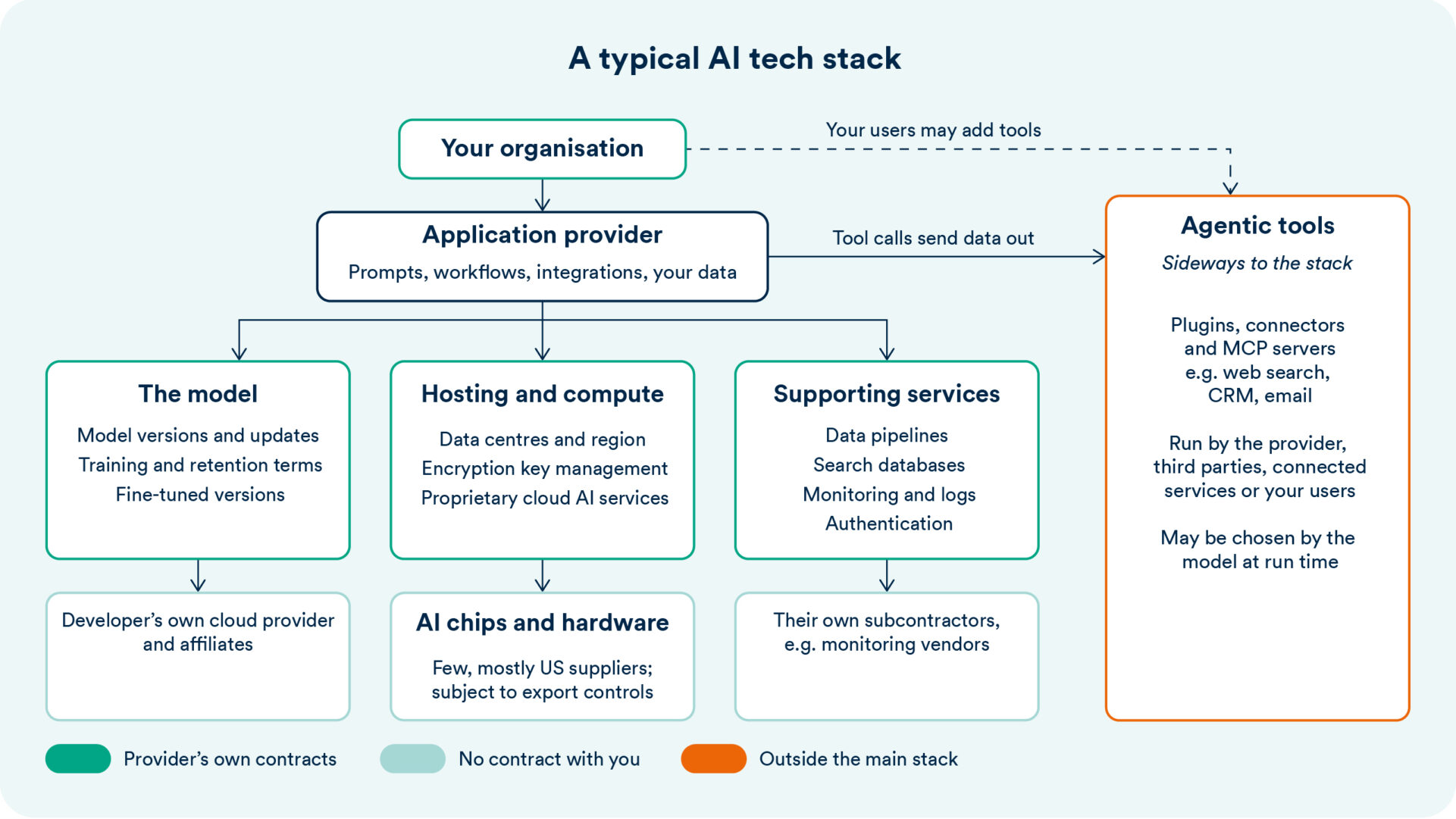
[Click the image to enlarge]
The application provider
The application provider supplies the tool and is usually the customer’s only contracting party. Many providers build on third-party models, cloud infrastructure and other services, so their commitments can only be as strong as the terms they have in place with those suppliers. Apart from open-weight model licences, which are publicly available to view, customers may not have any sight of applicable licence terms, so may have limited scope to check them. Alternatively, the application provider may simply flow down third-party terms, leaving it to the customer to determine where gaps lie.
The application layer is also where lock-in tends to bite first. Prompts, workflows and integrations built around the tool may only work on the provider’s platform, and the contract may not give the customer the right to export its data and configurations in a usable format, termination assistance, or adequate notice if the provider withdraws the product or fails.
The model
Most application providers do not develop their own proprietary AI models. Where a provider uses a third-party model, such as an LLM, through an API, the model developer’s terms will govern how long inputs are retained, whether its personnel can review inputs and outputs, and whether the customer data can be used for training or model improvement. Further, those terms may be subject to change at any time.
The model developer also determines when a model version is deprecated or withdrawn, sometimes at short notice, and access can be suspended for reasons outside either party’s control: as discussed in our first article, a US export control directive in June 2026 led to two frontier models being switched off for customers worldwide without notice. Moving to a replacement model is often not a simple swap, as prompts may need to be reworked, outputs revalidated and any fine-tuning repeated, and fine-tuned versions hosted on the developer’s platform may not be portable. Self-hosting an open-weight model reduces some of these dependencies, though not all (our next article in this series will compare the commonly-available options).
Hosting and compute
Data residency is often the main commitment behind a sovereignty claim but it does not determine who can access the data. A hosting provider may be subject to the laws of another country (such as the US CLOUD Act or China’s National Intelligence Law) and those laws could require it to disclose data wherever it is held. This could present issues for customers. For example, under the ICO’s international transfers guidance, making personal data accessible to a separate organisation outside the UK, including by remote access, could itself be a restricted transfer. Further, if the provider holds the encryption keys, data residency commitments will not necessarily prevent data access from outside the jurisdiction where the data is held.
Hosting also determines availability and the cost of leaving. A provider subject to foreign law may be required to suspend services, for example to comply with sanctions or export controls, and local data centres may have limited capacity for the specialised hardware that AI workloads require, so failing over to another region or provider is not always simple. Applications built on a cloud provider’s proprietary AI services can be costly to migrate, and fees for moving data out of a cloud environment add to the cost of exit (although the EU Data Act will abolish switching charges for many cloud services from next year).
Beneath the hosting layer, the supply of AI chips is concentrated in a very small number of mostly US companies and is itself subject to export controls. That limits how much capacity a “sovereign” provider can secure, and how much a domestic or self-hosted fallback can achieve.
Supporting services
Supporting services such as data pipelines, search databases and monitoring tools may each involve customer data and be run by different companies based in different jurisdictions. Logs are easily overlooked, but they often contain extracts of inputs and outputs. Wherever the logs go, customer data can follow. Supporting services can also be single points of failure: if an authentication, search or monitoring service goes down or is withdrawn, the application may stop working even though the model and hosting are unaffected. Search databases may also hold customer documents in a converted form that is specific to a particular model or provider and may need to be rebuilt on exit.
Agentic tools
AI applications are increasingly able to take actions as well as generate content. To do so, the model calls external tools through plugins, connectors and Model Context Protocol (MCP) servers, for example to search the web, query a CRM system or send an email. Each tool call can send customer data, including extracts of prompts, documents and earlier outputs, outside the stack described above. Some connectors are built and run by the application provider, but many are offered by third-party developers or by the services they connect to, and some may be added by the customer’s own users. These recipients of customer data may be unclear, may change without notice and may be selected by the model while it runs rather than set in advance. Each tool provider that receives personal data may be a further processor or a separate controller, and any transfers outside the UK would need to be assessed in the same way as for the other layers.
Tools also bring their own availability and lock-in risks. An agentic workflow that depends on a chain of tools may fail if any one of them is withdrawn or changes how it works, and workflows built around a particular provider’s agent ecosystem may be hard to move elsewhere. As applications become more agentic, this layer will become bigger and more important, and the part of the stack over which customers have the least visibility.
Customer constraints
Where an application is being licensed, the customer can negotiate directly with the application provider, only indirectly with that provider’s suppliers, and usually not at all with anyone further down the chain. A sovereign offering is therefore only as strong as its weakest layer, so customers should establish which layers and which risks a supplier’s commitments cover, treating sovereignty as a matter of degree rather than a guarantee.
Sector rules
For regulated customers, mapping the stack is not just good practice; it is required. Under the EU Digital Operational Resilience Act (DORA), financial entities must keep a register of their contractual arrangements for ICT services, covering the subcontractors that support critical or important functions, and must have exit strategies for those services. In the UK, the PRA and FCA’s outsourcing and operational resilience rules already require firms to map the people, processes, technology and third parties operating their most important business services.
Outside financial services, companies in scope of the EU’s NIS2 Directive must address security in their supply chains, including risks arising from their direct suppliers and service providers, and the UK’s Cyber Security and Resilience Bill (now in its final parliamentary stages) will bring managed service providers, data centres and designated critical suppliers into scope of the UK regime. An AI application is a third-party ICT service like any other, so for these customers each layer described above may fall within existing mapping, register and due diligence obligations.
A worked exampleLodestar Therapeutics, a hypothetical UK biotech developing a rare disease treatment, uses an AI tool to triage adverse event reports from a Phase II trial with UK and EU sites. Its UK supplier markets the tool as sovereign because the data is hosted in the UK. Six months later, a pharma company is conducting due diligence for a licensing deal and asks where Lodestar’s safety data has been processed and who could have accessed it. The safety data contains pseudonymised patient health data and unpublished safety information. Tracing the stack shows that Lodestar’s contract with the AI tool provider covers UK hosting, but not who else can access the data processed within the tool. The provider uses a US developer’s model whose terms allow inputs to be retained to check for misuse and do not rule out use for training. The US developer’s cloud provider holds the encryption keys, and the cloud provider’s support staff at an affiliate outside the UK can access customer environments. Error logs containing extracts from patient narratives go to a monitoring service outside the UK that Lodestar’s contract does not name. Lodestar therefore cannot simply answer “UK only”. These transfers may be lawful if an adequacy decision applies or appropriate safeguards are in place, but Lodestar will need to confirm this, as an inaccurate answer could put it in breach of any warranties it gives in the licence with the pharma company. Lodestar’s position is not unusual: most AI applications rely on several providers, and a sovereignty commitment from one of them says little about the others. Continuity is also an issue: if the US developer withdrew or suspended the model, Lodestar’s triage of adverse event reports, which must meet strict regulatory reporting timelines, could be disrupted at short notice, and its contract may give it no right to advance warning or help moving elsewhere. Mapping the stack at procurement stage and seeking firm contractual commitments from the application provider can help to mitigate sovereignty issues. |
What can customers do?
Scope it first
- Decide what data the application will handle and which factors matter most for that use: confidentiality, continuity, ability to switch, or compliance. Not every tool needs maximum sovereignty.
Map the stack
- Ask the application supplier to specify every supplier that processes your data or that the application depends on, where each operates, and which jurisdiction’s laws apply to it.
- For each layer, ask three questions: who can see the data, who can switch the service off, and how hard it would be to leave.
- Check the layers that are easily missed, such as connectors to external tools.
Contract for it
- Require a sub-processor list mapped to the stack, with advance notice of changes and a right to object.
- Get location commitments that cover where inference runs, where logs and backups are kept, and where support personnel access the system from, not just where data is stored.
- Require the provider to pass on the model developer’s commitments on how long inputs are kept and whether they are used for training, and to tell you when those terms change.
- Require notice before a model is withdrawn or changed, and the right to stay on a specific model version.
- Include commitments to notify you of government access requests and to challenge them.
- (We will cover contract tips in more detail in a future article in this series.)
Design for it
- Remove or pseudonymise sensitive data before it leaves your environment.
- Route model calls through a layer that lets you switch models without rebuilding the application.
- Keep a fallback model for critical processes.
Plan for exit
- Obtain rights to export your data, prompts, fine-tuned models and search indexes, plus termination assistance from the provider.
- Search indexes generally need rebuilding if you change embedding model, so budget for that.
- Include sudden loss of a model provider in your business continuity planning.