




Following Mercedes' win for its radiator-grille, this is another article related to the assessment of the distinctive character. In Mercedes-Benz Group AG v EUIPO (T-400/24), the General Court of the European Union (“GC”) upheld the refusal to register as an EUTM the representation of an all-terrain vehicle in relation to “motor vehicles, tyres and wheels”, finding that the sign lacked distinctive character.
Background of the case
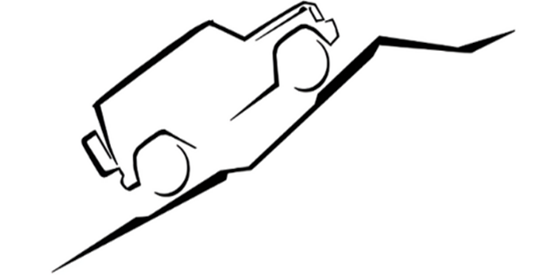
In December 2022, Mercedes applied to register the above figurative mark notably for "Motor vehicles and their parts; tyres and wheels" class 12 ("the goods concerned").
The EUIPO partially refused the trade mark application on the grounds that the mark lacked distinctive character. Mercedes appealed the decision. The Fifth Board of Appeal (the “Board”) dismissed the appeal, considering that the sign applied for depicted a conventional image of an off-road vehicle ascending a hill, featuring large tyres and an externally mounted spare wheel, thereby conveying characteristics typical of that category of vehicles. On that basis, the Board concluded that the sign lacked distinctive character, as the mark contains no element capable of being retained by consumers as an indication of commercial origin.
General Court’s decision
The Court applied the established case law on product-related signs. It reiterated that where a sign closely resembles customary representations of the goods themselves, it will only be distinctive if it departs significantly from sector norms.
Here, the Court considered that the Mercedes sign did not diverge meaningfully from common advertising imagery used in the automotive sector. On the contrary, the Court noted that the very simplicity of the sketch made it blend even more easily into the visual language of off-road vehicle promotion. Precisely because of the rudimentary nature of the sign applied for, and insofar as it does not correspond to any existing model of off-road vehicle, this sign is not easily distinguishable from other usual representations of this type of vehicle, even if the consumer were to pay particular attention to the products concerned.
Takeaways
The judgment underscores the strategic risk of relying on generic or sector-typical visuals as standalone trade marks. Figurative marks that depict the product itself, or its expected performance, face a high bar. Without a clear, memorable deviation from industry norms, registration is likely to fail.
The full decision is available here.
/Passle/5f3d6e345354880e28b1fb63/MediaLibrary/Images/2025-09-29-13-48-10-128-68da8e1af6347a2c4b96de4e.png)
/Passle/5f3d6e345354880e28b1fb63/SearchServiceImages/2026-10-13-15-35-40-862-6ace4fcca1503fba13b73b0a.jpg)
/Passle/5f3d6e345354880e28b1fb63/MediaLibrary/Images/2024-08-23-11-31-07-354-66c872fb971eecc249d83d40.png)
/Passle/5f3d6e345354880e28b1fb63/SearchServiceImages/2026-10-12-08-30-42-108-6acc9ab2e83f10ded8d0898d.jpg)